Guides & Tips4 min read
How to Use a Watch as a Compass
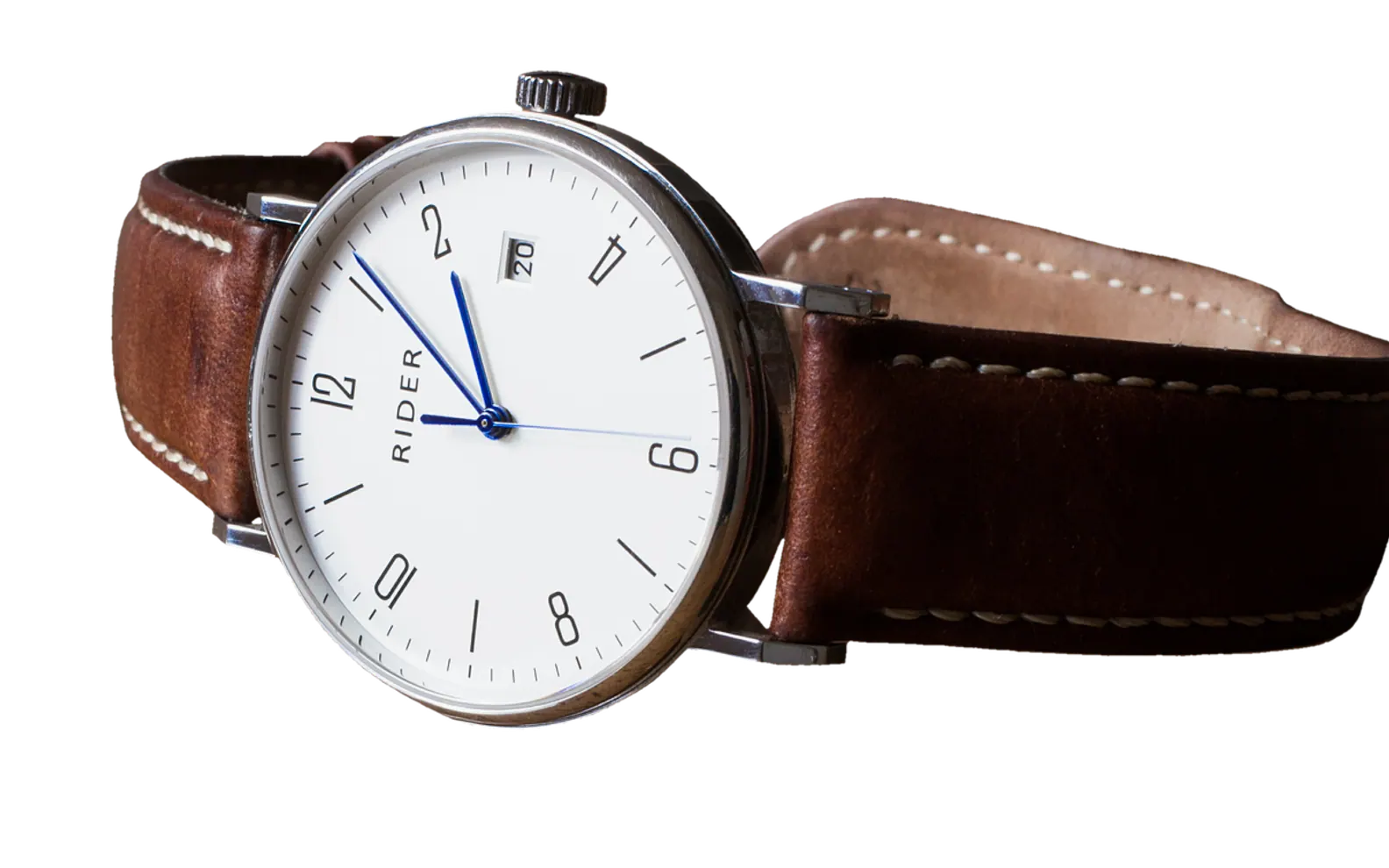
You can find rough direction with an analogue watch and the sun. In the northern hemisphere, hold the watch flat and point the hour hand at the sun; south lies halfway between the hour hand and the 12. In the southern hemisphere, point the 12 at the sun instead; north lies halfway between the 12 and the hour hand. It is an approximation, good enough to tell you which way a valley runs and no substitute for a compass.
Northern hemisphere, step by step
- Take the watch off, or hold your wrist level, so the face is horizontal.
- Turn it until the hour hand points towards the sun.
- Find the midpoint of the smaller angle between the hour hand and the 12 o'clock mark.
- That midpoint line runs north to south, with south at the end nearer the sun.
At four in the afternoon, for example, the midpoint sits at the 2. With the hour hand on the sun, the 2 points south and the 8 points north.
Southern hemisphere, step by step
- Hold the watch flat.
- Turn it until the 12 o'clock mark points towards the sun.
- Find the midpoint between the 12 and the hour hand.
- That midpoint points north.
Daylight saving time
The method assumes the watch shows standard time. When the clocks are set an hour forward for summer, use the 1 o'clock mark in place of the 12, or mentally wind the hour hand back an hour before you start.
How accurate is it?
Treat the result as a general bearing. Several things blur it:
- Latitude: the method works best in the middle latitudes. Near the equator the sun passes almost overhead and the result becomes unreliable.
- Time zones: clock time and sun time rarely match exactly, particularly near the edge of a wide time zone.
- Season and time of day: errors grow in midsummer and around midday, when the sun is high.
- Holding the watch level: a tilted face skews the angle.
Never point your eyes at the sun to line things up. Hold a twig or a blade of grass upright at the edge of the watch and turn the watch until its shadow falls along the hour hand, pointing back towards the centre.
What if the watch is digital?
Read the time, then draw a clock face on paper or scratch one in the dirt with the hour hand in the right place, and use the drawing exactly as you would a real dial. A phone showing the time works the same way, which is handy when its compass app has no calibration and its map has no signal.
What if the sun is hidden?
On a bright overcast day a faint shadow is often still visible on a pale surface such as a fingernail or a sheet of paper. Under heavy cloud, in forest or after dark the method simply does not work. That is the main reason it belongs in the "useful to know" category and a real compass belongs in the pack.
What is a field watch?
A field watch is a plain, tough wristwatch built for legibility: a clear dial with full numerals, strong luminous markings, a sturdy case and a strap that survives rain. The style grew out of military issue watches, and it remains popular with walkers because it is easy to read at a glance and has clear hour marks for exactly this kind of trick.
A dive-style watch does the job too, and its rotating bezel can be turned to mark the midpoint so you do not have to keep recalculating. Hobbyists who build their own often start from that sort of design; our piece on custom dials, hands and bezels on Seiko-based builds shows how many of those parts can be chosen.
Where this fits in real navigation
Direction on its own tells you little unless you also know where you are. Pair any rough bearing with a map, and learn to recognise ridges, valleys and saddles from contour lines; our guide on how to read a topographic map starts from the beginning. Before any walk, tell someone your route and return time, as set out in the guide to planning a hiking trip. On routes that last months, such as those described in our explainer on thru-hiking, small skills like this one earn their keep on the day a battery dies.
Quick answers
Does it work at midday?
At local solar noon the hour hand and the 12 nearly coincide, and the sun itself is due south in the northern hemisphere or due north in the southern. The watch adds nothing at that moment, and small errors matter most.
Does the minute hand matter?
No. Only the hour hand and the 12 are used.
Can it replace a compass?
No. A compass works in cloud, in woodland and at night, and it gives a precise bearing. The watch method is a backup for checking that you are broadly heading the right way.
Editor’s picks
 MoviesWhy IPTV Continues to Gain Ground Across France3 min read
 MoviesIPTV in the Netherlands: Enhancing Entertainment with Innovation and Convenience3 min read
 Guides & TipsCamping in the Rain: How to Stay Dry and Enjoy It4 min read
 ActivitiesA Fresh Start: The Benefits of End of Lease Cleaning in Melbourne3 min read
Through the years
2026
2025
- The IVG Pro: Design, Consistency, and Convenience for Adult Vapers
- From Site to Sorting: How Container Services Streamline Construction Projects in Germany
- Photo Booth Hire That People Actually Use: How It Turns Moments Into Shared Stories
- Gentle Tributes, Delivered: Ordering a Funeral Bouquet From an Online Flower Shop
- Silicon and Soil: Champagne’s Quiet Tech Upgrade
2024
- Why UK-Based SEO Agencies Are Leading the Way in Digital Marketing Excellence
- From Education to Entertainment: How AI Is Reshaping Learning and Leisure
- How Automation and AI Are Revolutionizing Google Ads Campaigns
- Space-Saving Illumination: How Recessed Lighting Enhances Small Rooms
- Crafting Comfort: Customizable Options for Retractable Awnings