Activities4 min read
What Is Tandem Skydiving?
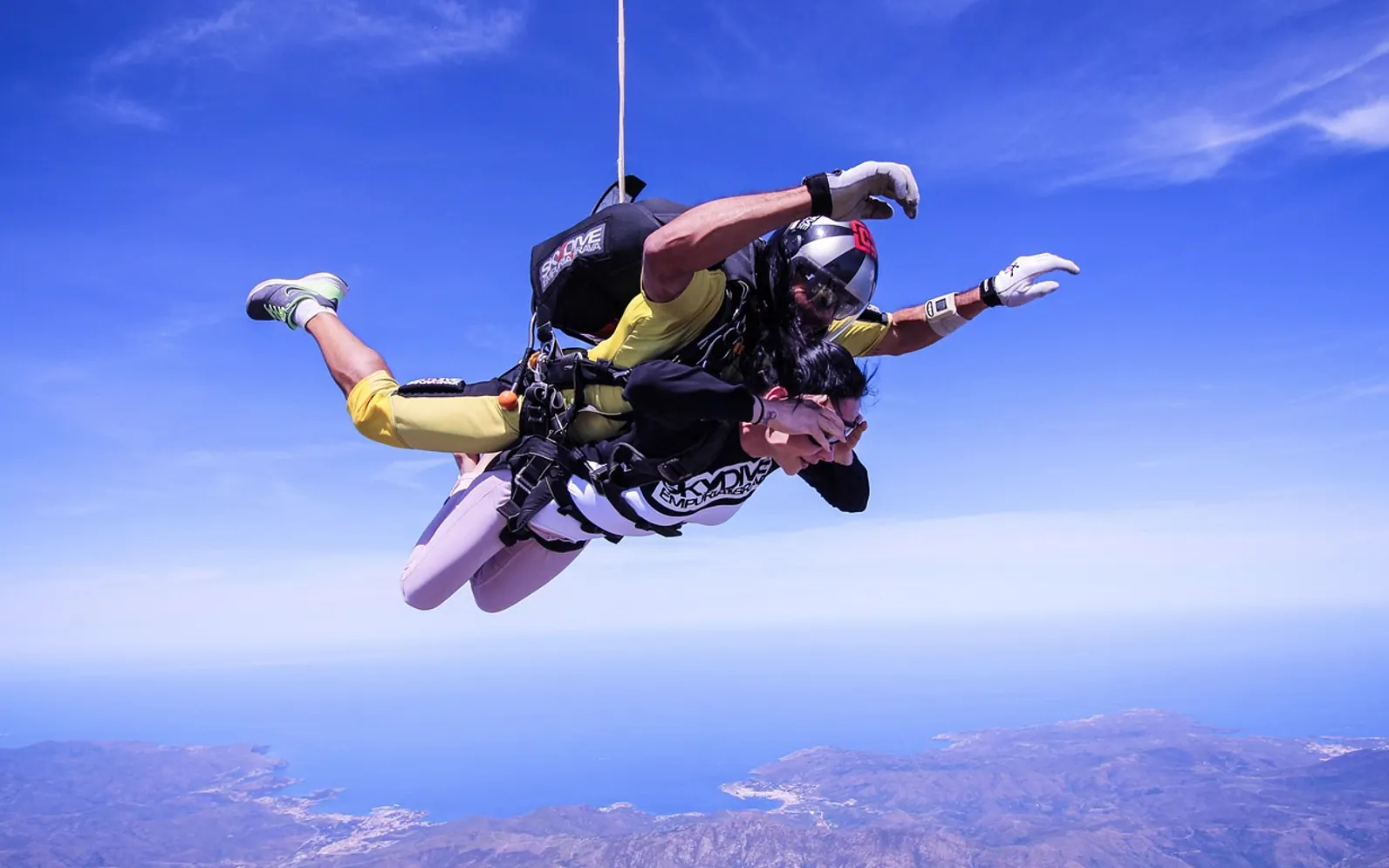
Tandem skydiving is a parachute jump in which a first-timer is harnessed to the front of a qualified instructor, who wears one large parachute system built for two. The instructor controls the exit, the freefall, the parachute opening and the landing. The passenger needs only a short briefing, which is why a tandem is how most people make their first jump.
How the day runs
- Check-in and paperwork. You sign a waiver and may be weighed. Expect questions about health.
- Briefing. An instructor explains the body position for exit and freefall, what to do with your legs on landing, and the hand signals used in the air. It usually takes well under an hour.
- Gearing up. You are fitted with a harness, and often a jumpsuit, soft helmet and goggles.
- The flight. The aircraft climbs to jump height. Shortly before exit, the instructor clips your harness to theirs at four points and tightens everything.
- Exit and freefall. You leave the aircraft together. A small stabilising parachute called a drogue keeps the pair steady and at a manageable speed. Freefall typically lasts less than a minute.
- Under canopy. The instructor opens the main parachute and the noise stops. The ride down takes several minutes, and you may be invited to help steer.
- Landing. You lift your legs as instructed and usually slide in seated, or step down gently if conditions allow.
Weather decides everything. Wind, cloud and rain can delay or cancel jumps at short notice, so keep the whole day free and expect some waiting.
Who can do it
Rules differ between countries and between individual dropzones, so check directly with the operator. In general:
- Age: there is a minimum age, commonly eighteen, though some countries allow younger jumpers with a parent's consent.
- Weight: every dropzone sets an upper limit, tied to the equipment, and may charge extra or decline above a certain figure.
- Health: heart conditions, epilepsy, recent surgery, back, neck or shoulder problems, and pregnancy are among the things operators ask about. If any apply, speak to a doctor before booking and tell the dropzone honestly.
- Alcohol and drugs: none beforehand.
What to wear and bring
- Comfortable clothes you can move in, with layers; it is colder at altitude than on the ground.
- Trainers that lace up firmly. No boots with hooks, sandals or heels.
- Long hair tied back, jewellery and loose items left behind.
- Glasses or contact lenses are normally fine under goggles; mention them at the briefing.
- Photo ID, water and a snack for the wait.
What it feels like
People often expect the stomach-drop of a rollercoaster and are surprised not to get it. Because the aircraft is already moving forward, the exit feels more like being held up by a strong wind than like falling. Freefall is loud and intense; the parachute ride that follows is quiet and slow, with time to look around. Nerves on the climb are entirely normal, and instructors are used to them.
How safe is it?
Skydiving carries real risk, and no operator can remove it. Tandem jumping manages that risk in several ways: instructors hold a specific rating that requires substantial prior experience, the equipment includes a reserve parachute, and tandem systems are fitted with an automatic activation device designed to open the reserve if the pair is still falling fast at a low height. Read the waiver properly, ask whatever you want to ask, and do not jump if something does not feel right.
If you are curious about the equipment on the instructor's back, our overview of how the container, harness and canopies of a rig work together goes through each part.
Choosing a dropzone
- Look for membership of the national parachuting association and instructors rated by it.
- Read recent reviews, paying attention to how the centre handles weather delays and rebooking.
- Ask what the price includes. Photos and video are normally extra.
- Ask about the jump height offered, the weight limit and the refund policy.
- Check how to get there; many dropzones are at small airfields with no public transport.
Fitting a jump into a trip
A tandem is not cheap, so it sits in the "one or two paid highlights" category that our guide to travelling on a small budget recommends choosing carefully. Put it early in a stay so there are spare days if the weather turns. Leave long hikes and anything strenuous for another day; the adrenaline dip afterwards is real.
Tandem, static line or AFF?
| Method | What it is | Best for |
|---|---|---|
| Tandem | Attached to an instructor throughout | Trying the experience once |
| Static line | A solo jump from lower height; the parachute is opened automatically by a line fixed to the aircraft | A first step towards jumping alone, where offered |
| Accelerated freefall (AFF) | A training course with solo freefall alongside instructors from the first jump | People who already know they want a licence |
Quick answers
Can you breathe in freefall?
Yes. The air rushes past, but breathing is normal. Shouting on exit helps if you find yourself holding your breath.
What if you are afraid of heights?
Many jumpers are. From jump altitude the ground looks like a map and the usual sense of height is often absent. Whether to go is still your call, right up to the door.
Can you jump more than once in a day?
Some centres allow it if there is space. Most people find one is plenty for a first visit.
Editor’s picks
 MoviesWhy IPTV Continues to Gain Ground Across France3 min read
 MoviesIPTV in the Netherlands: Enhancing Entertainment with Innovation and Convenience3 min read
 Guides & TipsCamping in the Rain: How to Stay Dry and Enjoy It4 min read
 ActivitiesA Fresh Start: The Benefits of End of Lease Cleaning in Melbourne3 min read
Through the years
2026
2025
- The IVG Pro: Design, Consistency, and Convenience for Adult Vapers
- From Site to Sorting: How Container Services Streamline Construction Projects in Germany
- Photo Booth Hire That People Actually Use: How It Turns Moments Into Shared Stories
- Gentle Tributes, Delivered: Ordering a Funeral Bouquet From an Online Flower Shop
- Silicon and Soil: Champagne’s Quiet Tech Upgrade
2024
- Why UK-Based SEO Agencies Are Leading the Way in Digital Marketing Excellence
- From Education to Entertainment: How AI Is Reshaping Learning and Leisure
- How Automation and AI Are Revolutionizing Google Ads Campaigns
- Space-Saving Illumination: How Recessed Lighting Enhances Small Rooms
- Crafting Comfort: Customizable Options for Retractable Awnings